RPN (Reverse Polish Notation) is a way to define arithmetic operations which very efficiently can be used for computer programs. A number of pocket calculators use this method as well as programming languages like FORTH.
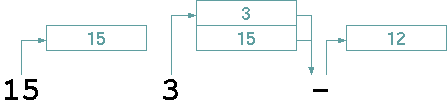
The example below illustrates how RPN works. Subtracting 3 from 15 you will be used to write as 15 - 3. This is known as infix notation, the operator (-) is written in between the arguments it works on. With RPN (aka. postfix notation) the operator appears behind it's arguments:
15 pushes this number on the stack.3 pushes the second argument on the stack, the number 3 now appears on top of the 15.- operator removes both numbers from the stack and replaces them by the result of the operation.With the sat-nms device driver language, RPN operations are not limited to plain arithmetic. The example below illustrates a string concatenation:
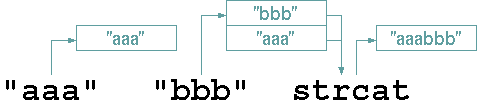
The stack is able to store objects of different data types. Numbers, boolean values and character strings may be used. RPN functions automatically convert the type of their input data as required. The stack generally is not limited in size (the computer's memory size however limits the stack).
RPN operations may take an arbitrary number of parameters from the stack and they may leave an arbitrary number of results there. This makes functions possible which are much more complex than a simple + or -. Furthermore, the stack may be used as a storage for intermediate results. This together allows to perform quite complex operations very efficiently.
There is one stack for each device which keeps it's contents between driver procedures and cycles. While this feature enables you to do very sophisticated things with the stack, you should be careful not to leave accidentally something on the stack at the end of an operation. The stack may grow with each cycle of the device driver, eating up slowly the whole available memory. Then, after hours, the MNC application aborts due to a lack of memory. There is a clr RPN command which clears the stack, you should call it at the end of an RPN sequence.