3.14.2.3 The Tracking Status Display
The lower right area of the ACU main window shows the tracking status display and the basic tracking mode parameters.
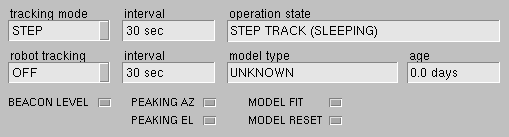
The table below gives a short description of each parameter in this area.
- tracking mode --- With this parameter you set the basic tracking mode. Available modes are OFF, STEP and ADAPTIVE. This parameter is passed to the ODM.
- interval --- With this parameter (upper row) you define in which intervals the ACU shall perform tracking steps. This parameter is passed to the ODM as well.
- operation state --- This field shows the general operation state of the tracking engine.
- robot tracking --- This switches the pointing robot ON or OFF. If the pointing robot is activated, the tracking mode is forced to OFF anf the antenna of moved on a path evaluated by the robot.
- interval --- The interval parameter in the lower row controls the update rate of the pointing robot.
- model type --- This status field displays the type of algorithm the pointing robot actually uses. Possible data sources may be Keplerian elements (NASA 2-line format), Intelsat ephemeris data or list of positions defined in a text file.
- model age --- Displays the age of the data used by the robot. With ephemeris data sets this is the time since the epoch of the data set. For file tracking the time stamp of the last record in the table is used as the epoch.
Below these parameter fields a couple of fault indicators (red lamps) are located on the screen. They report any faults of the tracking engine. The meaning of the individual faults are:
- BEACON LEVEL --- The beacon level is below the threshold and one of the tracking modes STEP or ADAPTIVE is selected. In STEP track mode the antenna freezes in this situation, in ADAPTIVE mode the antenna is moved along the model which has been calculated before the beacon disappeared.
- PEAKING AZ/EL --- The step track peaking failed for one of the axes. The tracking engine reports this fault if the position / beacon level pairs measured during the tracking cycle does not match the antenna pattern curve sufficiently. This may happen if the beacon values are too noisy or if there is no beacon reception at all and the threshold is adjusted too low.
- MODEL FIT --- If the variance of the measured peaks to the calculated model exceeds the 'jitter threshold' value, this fault is raised. This is an indication that either the measurement values are noisy or the model type is not appropriate for the satellite's motion.
- MODEL RESET --- If the ODM recognizes a 'MODEL FIT' fault at three consecutive tracking cycles, it presumes the model to be invalid and resets the model. This voids all recorded step track positions (they remain visible in the diagrams) and resets the tracking to the learning phase where no model is available.