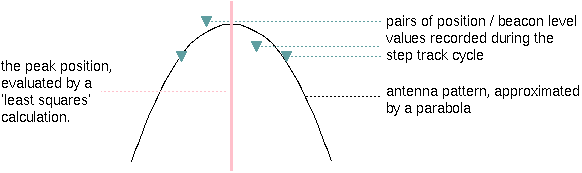
The principle of satellite step tracking is quite simple: For each axis, move the antenna a small amount away from the satellite, move it a small amount to the other site and finally point the antenna to that position where the signal is the strongest. The sat-nms ACU uses an optimized variant of this method which lets the tracking find the best pointing (‘peak’) with a minimum amount of depointing.
Within one step track cycle on one axis, the ACU does several very small steps. Using the position and beacon level values of all steps in the cycle, the ACU calculates the peak position by aligning the approximated antenna pattern to the measured points.
This method minimizes the impact of noise and measurement errors to the evaluated peak position. The benefit is, that the size of depointing steps can be reduced to a very small value.
A tracking cycle consists of 2 .. 4 tests steps. With each step the antenna is moved a certain angle increment, the beacon level is measured before and after the movement. The angle increment is an adjustable value, expressed as a percentage of the antenna’s 3dB beamwidth. A typical value is 15% of the (half) beamwidth.
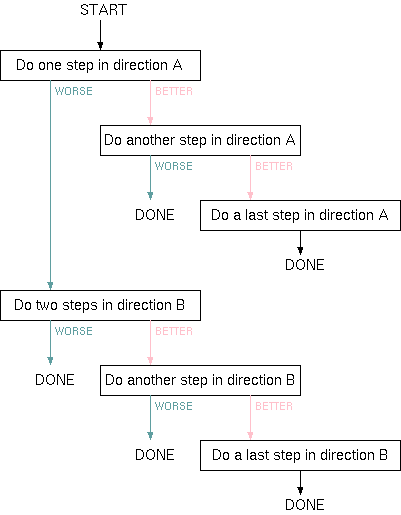
The diagram above shows the sequence of steps the tracking algorithm performs in one cycle on one axis. It starts with a depointing step in one direction (A). If this step lets the signal level decrease, the antenna makes a double step in the opposite direction. It the first step leads to a better receive level, the tracking algorithm adds one or two steps in the same direction.
For a reliable tracking operation the step size have to be big enough to reach the maximum within the 3dB bandwith within in the entered cycle time. This meas for an inclined satellite you need a shorter cycle time than for a geostationary satellite.