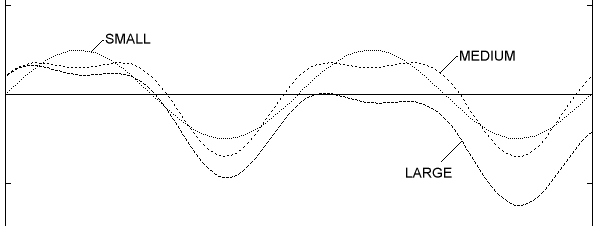
The motion of a geostationary satellite at the sky mainly is caused by an inclination of the satellite’s orbit with respect to the earth’s equatorial plane, sometimes also by the fact, that satellites decelerate in orbit. The motion seen from the antenna’s point of view can be described as the sum of harmonic oscillations with the frequency being multiples of the reciprocal of an sidereal day.
The mathematical models used by the sat-nms adaptive tracking algorithm to predict the satellite’s motion are finite sets of harmonic elements. The coefficients of the elements are evaluated from the step track data recorded for several hours or days by means of the least square fit method.
The more elements are included to a model, the better approximation of the true motion is possible. On the other hand, the number of data points used to evaluate a model is limited, the measurements values are distorted due to inaccuracy and noise. The more complicated a model is, the more susceptible it is to noise. For practical usage, there have to be used varying models, depending on the amount and quality of the recorded steptrack data.
Models
The ACU uses three different mathematical models to describe the movement of the antenna while it tracks the satellite. All models are based on sinusoidal functions with a cycle time on an sidereal day. The models called SMALL, MEDIUM and LARGE differ in their complexity.
The SMALL model, the simplest one, emulates the true antenna movement with a plain sine function. There are only three parameters with this model, the nominal antenna pointing, and the amplitude / phase values of the superposed sine. This model is very stable, gives reliable results even with only a few measured step track peaks.
Unfortunately the SMALL model does not fit optimally for all satellites. The MEDIUM model superposes a second sine wave with the double frequency (two cycles for one sidereal day). The model matches very good for almost all stationary satellites. It however requires more and also more precisely measured data points to give reliable results. The MEDIUM model is fully compatible to the SMALL one, this means that also satellites for which the antenna must follow a plain sine function may be tracked with the MEDIUM model. The amplitude of the double frequency sine simply is near zero in such a case.
Finally the LARGE model adds a linear movement to the components of the MEDIUM model. This is required to track significantly inclined satellites over a period of several days. Such satellites tend to drift in their position, the linear movement component can compensate this effect for a couple of days. The LARGE model is the most demanding one concerning the step track data it is based on.
Model selection
The ACU normally by itself selects the adaptive tracking model for each axis individually. The decision which model will be used in case of a beacon drop out is made based on the amount and quality of the data in the tracking memory.
The quality of the recorded data mainly depends on the amplitude of the antenna movement. If the satellite moves only a small amount in 24 hours, the uncertainty of the step track peaks is quite high compared to this amplitude. The ACU compares the movement amplitude to the antenna’s (half) 3dB beam width to evaluate this measure. The ACU presents this figure as a percentage value.
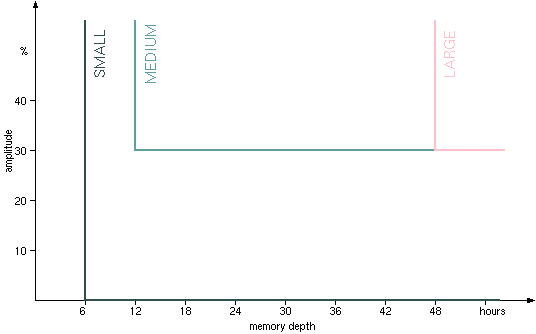
The ACU selects the adaptive tracking model following a scheme as illustrated in the diagram above. Below 6 hours data in the tracking memory there is no adaptive tracking possible at all. With at least 6 hours of data and 18 valid samples the ACU uses the SMALL model. If the movement amplitude is above 30% and there are at least 12 hours with 36 valid samples of data available, the ACU uses the MEDIUM model. The LARGE model requires 48 hours of data with 144 valid samples and an amplitude value of 30%. (Beside the recorded hours of steptrack the ACU also watches the number of samples. With a tracking interval of more than 15 minutes, the required times may be longer than shown in the diagram.
The ACU provides a ‘max. model’ parameter for each axis. You may limit the model size to a smaller one than the ACU would choose by itself. The other way round it is not possible to force the ACU to use a model it has not enough data for.
If the tracking results are bad, the ACU will not be able to calculate a model and set the model to NONE. This occurs also if only one axis have bad tracking results.
Quality information
As mentioned above, the amplitude of the satellite’s movement is used as a measure of the step track quality. This is because the step track measurement uncertainty is an constant angle which primarily depends on the antenna size.
Beside the amplitude, the ACU evaluates for each axis a figure called jitter. The jitter value describes standard deviation of the measured peak positions with respect to the positions calculated from the model. The figure is also expressed as a percentage of the antenna’s beamwidth, low values indicate, that the model ideally describes the antenna’s path. High values indicate that’s something wrong. The step track results may be to noisy at low amplitudes or the model does not fit at all. This may be the case if a satellite gets repositioned in the orbit.
You may set a threshold value for the jitter. The ACU raises a fault if at least one axis exceeds the threshold value. If this happens three consecutive times, the models gets reset, all data in the tracking memory gets marked invalid.