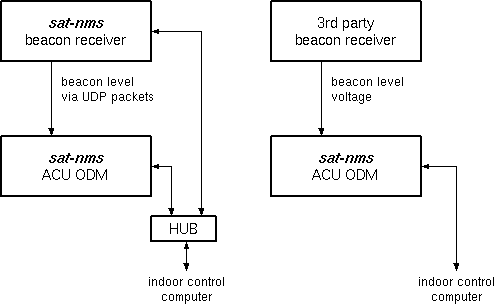
To perform a step track, the ACU requires the actually measured beacon level as a rate of the received signal quality and therefore the closeness of the antenna pointing to the ideal value. The sat-nms ACU is capable to be operated both with the sat-nms LBRX beacon receiver and with third party beacon receiver products.
With a third party beacon receiver, the ACU reads the beacon level from an analog voltage input. The beacon receiver therefore must provide a dB-linear output voltage, preferably in the range 0…10V. If the sat-nms beacon receiver is used, then the beacon level is sent from the beacon receiver to the ACU via UDP packets on the LAN.
If a sat-nms LBRX beacon receiver is used with the ACU, it additionally gets connected to the ACU through an Ethernet cable. Usually an Ethernet hub is used to connect the ACU, the LBRX and the controlling computer. With a sat-nms LBRX beacon receiver some additional features are available for the tracking:
For a well functioning step track with a third party receiver, it is important to adjust the voltage level range to the scale and offset provided by the beacon receiver. If at the beacon receiver these values may be adjusted too, a preferable scale is 0.5V/dB for 20dB usable range. The offset should be adjusted, that the receive level at clear sky conditions leave a headroom of 3dB at the top end of the range. The analog voltage never should reach the physical limit of 0V/10V under normal conditions. Clamping the level voltage probably will misslead the tracking.