Beside the network interface, the sat-nms LFTXRX also provides an RS232 serial port which can be used to control the device remotely. Depending on the device address set, the LFTXRX either runs framed protocol with start/stop characters and checksum or it provides a dumb terminal interface. The RS232 interface operates by default at 9600 baud, no parity, 8 data bits, one stop bit.
You can configure the baud rate on the front panel.
If an address 'A' .. 'G' is selected , the LFTXRX expects each message it receives to be packed into a frame as described below.
| char # | example | description |
|---|---|---|
| 1 | { | start character, always ' {' |
| 2 | A | device address (A..G) |
| 3 | t | first character of the message body |
| . | m | message body ... |
| . | p | .. |
| . | 0 | .. |
| . | = | .. |
| n-1 | ? | last character of the message body |
| n .tc} | end character, always '} ' | |
| n+1 | . | checksum |
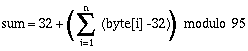
The checksum byte is calculated using an algorithm as implemented by the following formula:
This protocol type is known as MOD95- or Miteq protocol . The LFTXRX also packs it's reply in a protocol frame as described above. incomplete frames, checksum errors or address mismatches let the device ignore the message. The time between the characters of a message must be less than 5 seconds or the device will treat the message as incomplete.
If the LFTXRX is set to the device address 'NONE', it uses a simple line protocol instead of the framed protocol described above. Messages sent to the device have to be terminated with a carriage return character (ASCII 13), the device terminates replies with a CR/LF pair (ASCII 13/10). There is no echo for characters entered, hence this protocol easily may be used for computer based remote control.