
General Description
The calculation of atmospheric attenuation from measured sky noise temperature is described above in equation 5.22. It is also possible to calculate the atmospheric attenuation for different frequencies than the measurement frequencies in the range of 10 to 40GHz (Frequency Scaling). A number of empirical models, developed by experiments can be found in the literature.
The algorithms determines indirectly the atmospheric attenuation from measured sky noise temperature at two or more frequencies via calculation of water content in form of water vapour content V(θ) and liquid water content L(θ). The atmospheric attenuation is predominantly caused by absorption in gas molecules (water vapour and oxygen) and in water droplets in clouds and fog.
The accuracy of calculated attenuation depends on the uncertainty of V(θ) and L(θ). For attenuations up to 1,5dB and an uncertainty bettern than 10%, the accuracy better than 0,1dB is possible. Models are valid for non-rain conditions and up to an intensity less than 7mm/hour. Larger intensity, larger drop size and other effects will overshadow the non-rain contributions and the results become invalid. Due to the fact of different calculation algorithms, also the results could differ from each other.
The following models or algorithms are implemented at sat-nms RMC:
If there is a single channel radiometer or other frequencies than 31.7GHz, 23.8GHz or 21.3GHz, than you must disable frequency scaling. Otherwise the calculated results are wrong.
The associated algorithms are primarily based on a relationship between the total attenuation A at a given frequency f and direction (elevation angle θ) and the contribution of the different atmospheric constituents:
The variables for water content V(θ) and L(θ) are determinded from sky noise temperature measured in the same direction and are calculated for each model in a different way.
The coefficients a(f), b(f), c(f,θ,Z_0) describes:
Specific attenuation due to water vapour: 
Specific attenuation due to liquid water: 
Total attenuation due to dry-air molecules: 
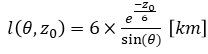
Water Content Calculation
The three different models or algorithms CCIR, SIGMA A and SIGMA B are calculating the water vapour V(θ) and liquid water L(θ) in a different way. The calculations are described in the following sections.
All threewater retrieval algorithms are based on sky noise temperature measurement at two different frequencies. At the KA-1 Radiometer the following frequencies are implemented and used:
The following two frequency pairs are used for the algorithm:
Sets of coefficients have been calculated for the sky noise measuring frequency pairs above. They are stored in the file MODEL.TXT stored on sat-nms RMC. Do not change the style of this file, otherwise the results will be faulty.
A unified terminology is used in the retrieval models. Thus the opacity r is generally used instead of attenuation A. All algorithms have been established for a nominal zenith pointing situation as a common point of reference. This zenith values for V and L are converted to the actual antenna pointing.