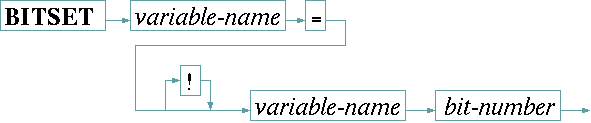
Some devices report their fault state as a number in which each bit represents one fault flag. The BITSET statement is used to decode flags from such a status value. Usually the fault status is read into an internal variable if the driver. Then the fault bits are decoded from this internal variable using the BITSET statement.
The bit position zero addresses the least significant bit in the source variable. The destination variable gets set to 1 or true if the addressed bit is set, to 0 or false if not. If the variable name is preceded by an exclamation mark, this mapping is inverted.
Example
        INPUT internal.flags
        BITSET faults.01 = internal.flags  4    // Temperature
        BITSET faults.02 = internal.flags  5    // Signal level
        BITSET faults.03 = ! internal.flags  11 // Video lock (inv)
        BITSET faults.04 = ! internal.flags  9  // Audio lock (inv)
        BITSET faults.05 = internal.flags  13   // High BER
        BITSET faults.06 = internal.flags  15   // Demodulator lock
        BITSET faults.07 = internal.flags  14   // Conditional Access
The example above reads a value into the variable internal.flags. BITSET statements are used to extract seven faults flags from this variable. internal.flags must be declared READONLY to make this example work.