Beside the network interface, the DEICE-Controller also provides an RS232 serial port which can be used to control the device remotely. Depending on the device address set, the DEICE-Controller either runs framed protocol with start/stop characters and checksum or it provides a dumb terminal interface. The RS232 interface always operates at 9600 baud, no parity, 8 data bits and one stop bit.
If an address 'A'...'G' is selected, the DEICE-Controller expects each message it receives to be packed into a frame as described below.
| char # | example | description |
|---|---|---|
| 1 | { | start character, always ' {' |
| 2 | A | device address (A...G) |
| 3 | t | first character of the message body |
| . | m | message body ... |
| . | p | .. |
| . | 0 | .. |
| . | = | .. |
| n-1 | ? | last character of the message body |
| n | } | end character, always '} ' |
| n+1 | . | checksum |
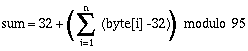
The checksum byte is calculated using an algorithm as implemented by the following formula:
This protocol type is known as MOD95- or Miteq protocol . The DEICE-Controller also packs its reply in a protocol frame as described above. Incomplete frames, checksum errors or address mismatches let the DEICE-Controller ignore the message. The time between the characters of a message must be less than 5 seconds or the DEICE-Controller will treat the message as incomplete.
If the DEICE-Controller is set to the device address 'NONE', it uses a simple line protocol instead of the framed protocol described above. Messages sent to the DEICE-Controller have to be terminated with a carriage return character (ASCII 13); the DEICE-Controller terminates replies with a CR/LF pair (ASCII 13/10). There is no echo for characters entered; hence this protocol easily may be used for computer based remote control.