2.5 Connecting the sat-nms LFTXRX
The connectors of the chassis are placed on the front and on the rear side. The Front side contains the fibre optic connectors and the L-Band test-ports, the rear side contains the corresponding L-Band In/Out connectors and also the the AC-power and Data-connectors.
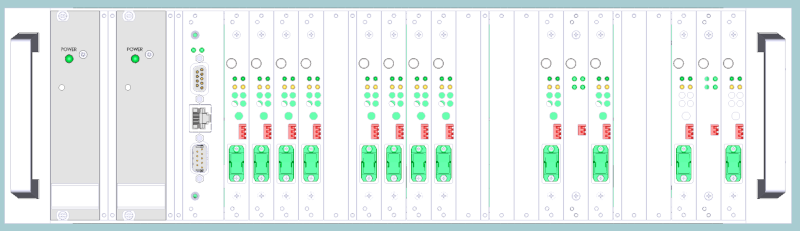
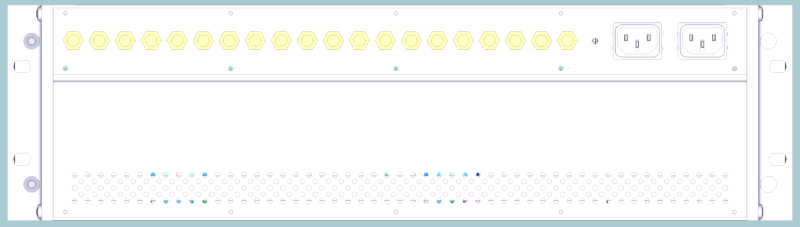
When you connect the L-Band Optical Link chassis, please consider the following:
- J1.2 LAN is the Ethernet 10/100Base-T / RJ45 connector. Use a standard network cable to connect the LFTXRX to an Ethernet hub or switch. If you want to connect your computer and the unit directly without using a hub, you need a crossover cable for this with swapped RX/TX lines. To meet mentioned EMC standards, use double shielded twisted pair CAT7 S/FTP Network cable, e.g. DRAKA UC900 SS27 Cat.7 PUR. Take care, that cable shielding is connected properly.
- J1.1 serial is a standard 9-pin RS232 (DCE) SUB-D pin-connector. You may use a direct 9-pin cable to connect a PC to the LFTXRX. To meet mentioned EMC standards, use double shielded twisted pair CAT7 S/FTP Network cable, e.g. DRAKA UC900 SS27 Cat.7 PUR. Take care, that cable shielding is connected properly.
- J1.3 Alarm is a standard 9-pin SUB-D socket-connector. This connector contains the alarm contacts of the internal failure relays. To meet mentioned EMC standards, use double shielded twisted pair CAT7 S/FTP Network cable, e.g. DRAKA UC900 SS27 Cat.7 PUR. Take care, that cable shielding is connected properly.
- PS1 and PS2 are mains power-inputs. Only use IEC plugs with an earthing contact and protective earth connection to connect the power supplies. Do not forget to connect the "GND"-labelled screw to the PE potential.
- The input, output and test-port RF-connectors are all SMA/50Ohm female in the standard configuration. 75Ohm F-type is available on special request. Use double shielded coaxial cables, e.g. RG223, only.
- The fibre optic connectors are E2000 or FC/APC types depending on the configuration. It is essentially to use single mode cables with 8° angled polish for proper function.