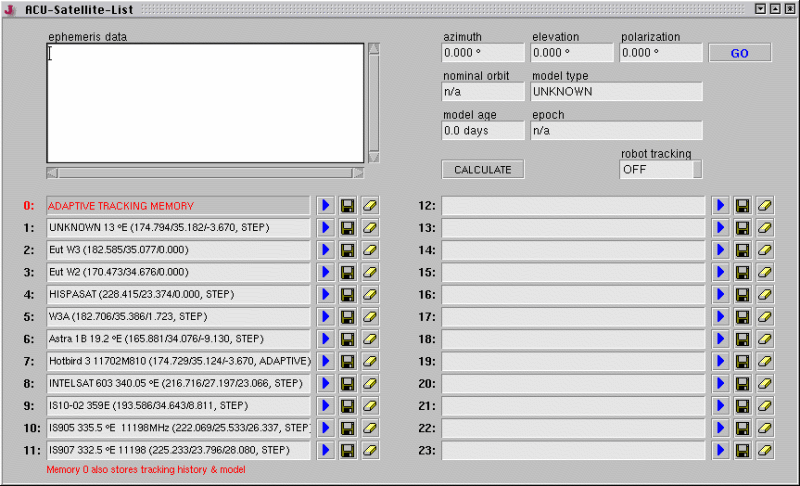
The satellite select screen combines two functions for pointing the antenna to a satellite's position: The entry of ephemeris data to the pointing robot and the administration of the ACU's target memory locations.
The upper part of the screen is used to feed the pointing robot with the ephemeris data this requires to point the antenna to the satellite's position.
The usage is very simple: Copy the ephemeris data from e.g. your web browser window into the 'ephemeris data' field and click to the 'CALCULATE' button. The software tries to identify and parse the data and sets the informational fields on this right site to the values computed from the data. The 'azimuth' / 'elevation' / 'polarization' files show the antenna pointing which actually lets the antenna look to the satellite. The values below describe the type and the age of the ephemeris data set.
The pointing robot is capable interpret several types of ephemeris data including Keplerian elements in NASA 2-line format, Intelsat data, plain orbit positions and tables of az/el/pol value triples. The description of the Pointing-Robot logical devices describes the recognized data formats in detail.
The button 'GO' lets you make the pointing robot assist you in finding a satellite: Enter the satellite's nominal orbit position (or it's ephemeris data, if known), then click to 'CALCULATE', verify the calculated antenna pointing anf finally click the 'GO' to let the antenna move to this position.
The lower part of the screen manages the permanent storage of satellite parameters. Up to 24 satellites may be stored. The target memories store the antenna pointing and all tracking parameters. They are physically stored at the ODM's flash memory. If the ODM gets replaced, the stored positions are lost.
The ACU also stores the beacon receiver settings together with a target. These are stored at the beacon receiver itself. The ODM, when receiving a command to store or recall a target memory, sends a command to beacon receiver to do the same.
 --- Recalls this preset. The antenna is moved to the stored position, all tracking parameter are set as stored and the beacon receiver's parameters are set from the values stored with the preset. The tracking memory is cleared if a target memory is recalled. Only if the target number 0 is recalled, the tracking memory is restored to the state when this target was saved.
 --- Stores the actual settings in this preset. The satellite name, the actual pointing and all tracking parameter are stored in the preset. The beacon receiver parameters are stored as well.
 --- The preset memory with this number is deleted.
The target memory location 0 is a special one. Unless the other memory locations, this first one stores the contents of the tracking memory and all temporary tracking data like models etc. together with the position and parameters.
This makes the first memory location dedicated to the short time storage of a satellites tracking state, when another satellite shall be tracked for a couple of hours. Example:
The antenna is tracking satellite A for a long time, the tracking memory is filled with 70 hours of step track data for this satellite. During a maintenance phase, the antenna shall temporarily track satellite B. With the target 0 memory you would handle this situation as follows:
You should consider that it only makes sense to reuse the stored tracking data if there is less than twelve hours of discontinuity in tracking the satellite. If too much data is missing, clearing the tracking memory wil give the more reliable results.