
The sat-nms L-Band optical transmitters and receivers were developed to cover all applications in the field of satellite communication, satellite ground stations, VSAT and cable networks. The following block diagram shows a typical scenario of a teleport. The LNCs at the different antennas provide L-Band output signals which have to be routed via long cable runs from the antennas to a central site, in this case a switch matrix. The optical transmitter converts the analog L-Band spectrum (or any other RF spectrum in the specification of the different modules) with the help of a laser diode to a optical output signal with a wavelength of 1310nm. This is the standard wavelength used by most of the laser diodes. But it is also possible to select another wavelength on request by selecting another laser diode.
This example shows a satellite receive and transmit application with two antennas and at different locations, but with one sat-nms LFTX/RX chassis which handles all signals from both antennas and the uplink signal to the second antenna. In this case the satellite modulator delivers its L-Band or 70MHz signal to the optical transmitter located for example in the central building and at the end of the optical fibre link a optical receiver regenerates the RF signal spectrum which can be delivered for example to a block up-converter (BUC).
As already explained in this TX application it is also possible to provide the 10MHz reference frequency for the BUC via the same optical link. You can see in this block diagram also the redundant configuration of the receive path from the first antenna.
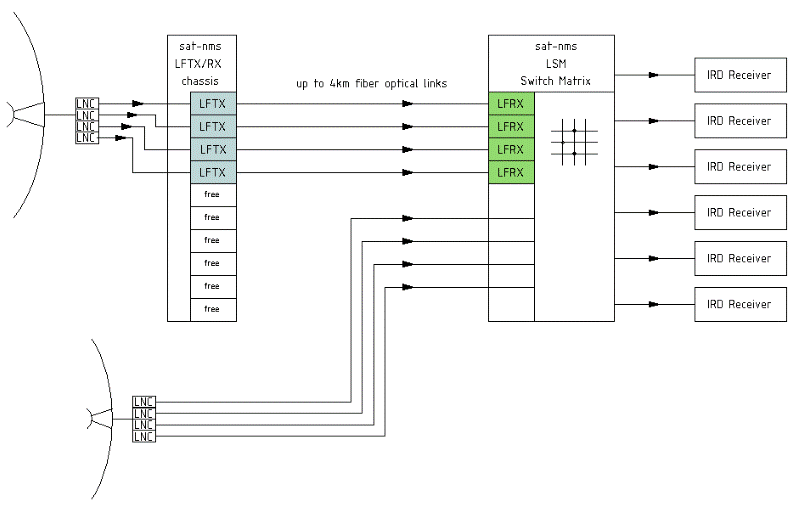
The second block diagram shows the combination of the sat-nms LSM L-Band Switch Matrix with the sat-nms LFRX L-Band Fibre Optical Receivers. So you use the LFRX card directly in our switch matrix.